

Inspired by Anxiety: The Best Things
/I’ve said it before, and I’ll say it again because I firmly believe it: Everything. Is. Connected. If you can try to embrace that idea, then the solution to any particular source of anxiety may not come from just one area of our lives, but be pieced together by taking action in many other areas. While each post in this series is devoted to a particular dimension of health, there will inevitably be some overlap, which I’ll acknowledge as well. With that said, on to the next dimension:
The Best Things
(Financial Health)
The rich can’t get enough of it. The poor can’t get enough of it. We stress over it— how much of it we have or don’t have and how to accumulate more of it— to the point where we sometimes obsess over it.
Money, money, money, money, money.
via Giphy
They say it’s the root of all evil. They say it is time. that you have to spend it to make it, and that it doesn’t grow on trees. They say that you can’t take it with you, and that the mo’ you have of it, the mo’ problems you have. They say the best things in life are free, but I can’t help but wonder if as soon as someone figured out how to charge for those things, “the best things” in life would be $5.99 a month with an annual subscription “deal” for only $50 a year… but I digress.
So much can be said about money, its virtues and its flaws. It’s the currency by which we assign value to anything and everything, including each other. And yet, if we took it all away the world would keep on spinning. Comedian Dane Cook once quipped that we accept excess amounts of ketchup packets from servers at fast food restaurants as though one day ketchup packets would be our currency (link contains strong language).
As ridiculous as that might sound, it’s kind of true. If tomorrow all of the money in the world disappeared, we’d probably find something else to put in its place as the marker of value, and fight over that instead. Like it or not, money is today’s currency and until ketchup packets take over we’re going to have to think mostly in terms of money when it comes to our financial well-being.
Before reading further, you should know that I’m not a financial expert. I wish I could offer sound tips on which stocks to buy low and sell high on but unfortunately, I’m not that guy. Thankfully, this isn’t so much a post about finance itself as it is about the mentality of finances and how they intersect with our mental health. So while I can’t advise you on investments, what I can do is speak to the effect things related to money has had on my mindset and ways to handle, if not avoid some of those pitfalls.
Where Did You Come From, Where Did You Go?
No, this isn’t about to devolve into Cotton-Eyed Joe, but it’s probably a good idea to have a sense of where your money is coming from and where it is going. Technology can be a wonderful thing, but with anything and everything becoming automated in today’s world, it can be easy to forget about our finances. As convenient as it may be to set up automatic bill pay, it can be just as easy to become detached from managing our accounts because frankly, you barely have to anymore.
Seriously though, when was the last time you handled money? Not a credit card, not a debit card, not scanning your phone, but actual, physical dollar bills? For many of us, it’s probably been a while, and because of that, it may stress us out when all of a sudden we get that notification telling us our account is overdrawn.

via Tenor
This is where actively and consciously keeping track comes in. This is not a novel idea by any means, but in terms of anxiety, I’ve found that it helps to know what you’re spending money on and when your balances are running low before it actually happens. It’s never a good thing to need money only to realize you don’t actually have it. That may mean stopping the automatic payments and setting a reminder to make those payments ourselves.
Of course, I realize that what eases anxiety for some people may cause it for others. If you have a lot of expenses but not a lot of money, I can understand how keeping track of these things may be an overwhelming reminder of how tight money might be. Still, keeping track of even our most basic finances (think: how much will I make this month versus how much do I plan to spend?) incorporates a level of consciousness that can help us manage our funds better.
It doesn’t have to be anything crazy or complicated. Personally, I’m a spreadsheet guy, so what helps me is keeping a basic list or chart but like I said before, technology can be a wonderful thing. There are many apps out there that can help you log your monthly income and expenses. It may take you a few downloads and trials with different apps to find one you like, and a few minutes to enter the numbers manually as you track, but that awareness can make a big difference in truly understanding how to manage your finances.
If you happen to like charts the way I do, here’s a simple one I made up that might be useful to you:
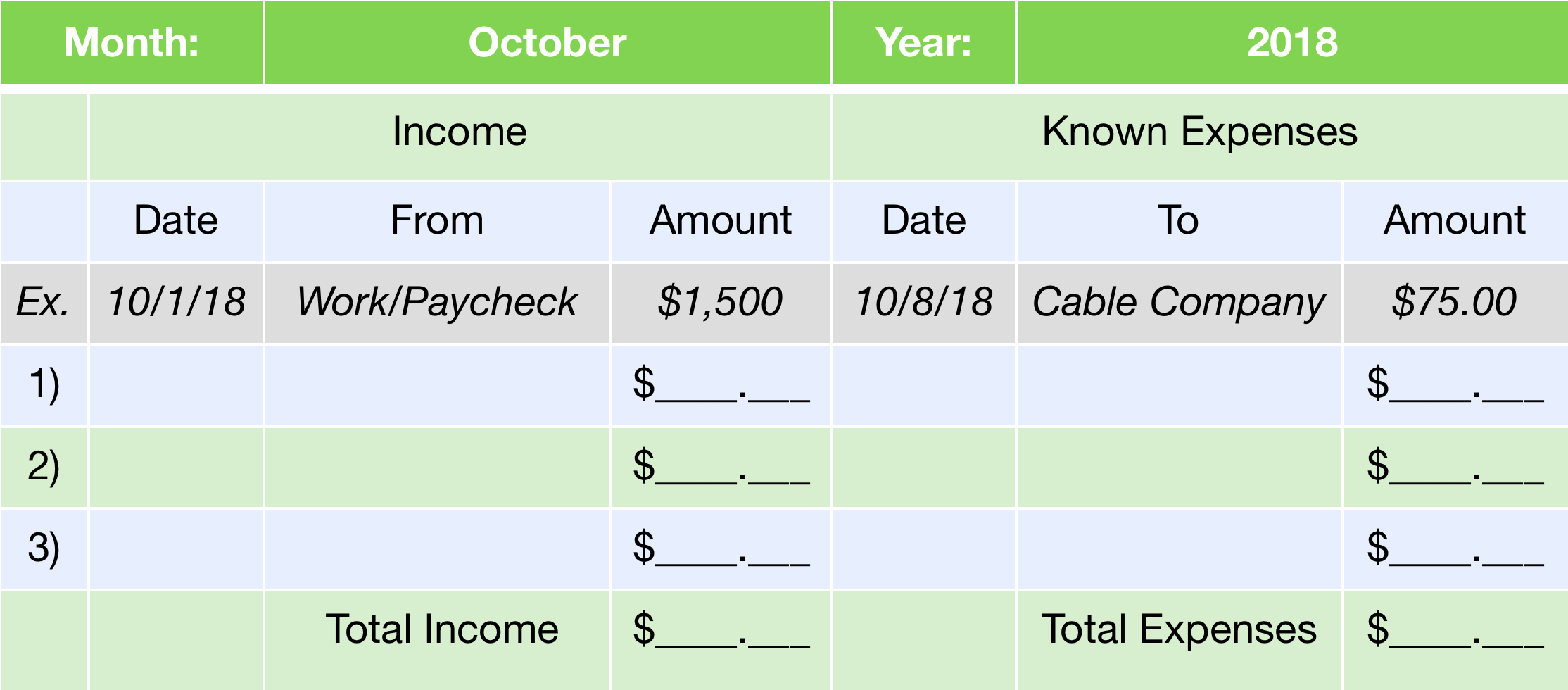
Credit: Mike Trovato
Priorities
This one is relatively straightforward and is, once again, probably not a novel idea, but if you were overwhelmed by tracking, prioritizing may help bring your anxiety down a notch or two. I don’t mean anything complicated by this piece either. Simply put, prioritizing your finances is a matter of asking yourself a couple simple questions about the items that cost you money in your expenses column:
Is this item something I need?
If the answer is yes, keep it on your list. If it’s no, consider ways to reduce the cost or get rid of it entirely, at least until you have enough money to justify it. I love and may want pizza, but I don’t necessarily need pizza for lunch at work 3 times a week, and I can probably cut back to once a week, every other week, or even once a month.
I realize that distinguishing between what we want and what we need can be difficult, and at times, there may be a gray area. Things like coffee also fall into this category. I also realize the idea of cutting back on or cutting out coffee may spark a brief moment of anxiety for many of us. I know quite a few people who would go to great lengths not to live without their coffee. But, the fact of the matter is that those fancy lattes from your favorite coffee shop at $5, $6, $7 a pop do add up.

via Tenor
Put it this way: Let’s say you buy a $5 cup of coffee on your way to work 5 days a week. If the average month has 20 weekdays/workdays, that’s $100 a month, $1,200 a year. If you’re spending closer to $7 on that daily coffee, make it $140 a month,$1,680 a year, or $30,240 over the course of the 18 years it would take a to have a child, raise them, and sent them off to college… Just saying. A homemade cold brew is easy to prepare and can give you that boost of energy without draining your bank account.
Am I getting my money’s worth/Is this “deal” really a “deal"?
A gym membership, in theory, is a great thing. It allows you access to a workout space with equipment you may not otherwise be able to use at home. If you use a basic gym membership— think the base membership at Planet Fitness for $9.99 a month— regularly, this is probably a great value for you. But of course, life happens, our routines get thrown off track, and we find ourselves going weeks and months at a time skipping out on going to the gym.
$10 a month may not be much, but if you’re only hitting the gym a few times each season, $159 ($120 plus the $39 annual charge) is a lot to spend on 10-15 visits a year. It may be more worthwhile to cancel that membership and build walking, bike rides, or running into your schedule. Investing even $100 into some basic home gym equipment can last you more than a year and get you an adequate workout, at least until you’re back into a routine that allows you to justify the gym membership again.

This concept also goes for subscriptions to magazines that you wind up skimming, tossing aside and forgetting about, then recycling months later having barely creasing the pages, or appliances that look cool but realistically you’ll use them twice before storing them in a closet until you move to a new place, then dumping because it doesn’t make the cut. A low-cost subscription cost may seem affordable, and the infomercials may make the appliance seem indispensable. If you’re not going to use them to their fullest potential, though, pocket the money for something more worthwhile like taking a cooking class or something that will help you learn a new skill.
Honesty and Discipline
To me, mental-financial health is ultimately about the way we approach and interact with our money and the people we allow to have access to it. This could be your parents, friends, or significant others, or simply yourself. But regardless of how many or how few people have that privilege, it’s important to be honest about your financial situation. This ties into the first two segments of this post, too; keeping track and prioritizing are great, but without discipline and honesty they may not be nearly as effective for you when managing your finances.
When I say be honest, I don’t mean to broadcast on social media how much money is in your savings account— in fact, I don’t recommend that at all. Simply put, don’t lie to yourself and trick yourself into thinking your situation is something it isn’t. This may not be easy especially if money is tight, and acknowledging debt might bring on some anxiety in itself.
via Giphy
The flip side of the coin, however, is that we may bring even more anxiety upon ourselves by over-exaggerating what we have, or downplaying what we owe. If you don’t have the money to spend, don’t spend it. No matter how badly you might want that slice of pizza, cup of coffee, or gym membership, it’s probably best to be honest and disciplined about it.
Lastly, money can be a sensitive subject that can drive a wedge between friends, family, and loved ones. If you’re at a point in your life where you’re sharing a bank account with a significant other, I recommend keeping honesty about your joint finances as part of the honesty within your relationship. Talk to each other about your expectations for how, and on what things you’ll spend your shared money, whose responsibility it will be to pay which bills, and what things you can afford and where you may need to cut back. Track and prioritize your finances together; it may still cause some anxiety, but it can be comforting to share that with someone and problem solve together than to have to go it alone.
It’s common for money to be a source of stress. If you find yourself feeling anxious about your financial health, believe me, you’re definitely not alone. Knowing what money you have and where it’s going can give you a sense of your spending habits, and prioritizing those expenses can help you budget for the things you truly need. All of these things take discipline, which of course takes time and practice. You may never fully be at ease when it comes to money, but the way we think about and approach our finances can help to be our coping mechanism for that financial anxiety.
What helps you manage your anxiety about money?
How do you track your finances— with an app, or on paper the old school way?
Share your comments at the bottom of the page.
Whatismyhealth © 2018


























THE environment is the Earth’s environment as a whole, but think about OUR environment and what’s around us.