What Is My Health
  • Home
  • The 8 Dimensions of Health Physical Health Mental Health Intellectual Health Social Health Environmental Health Financial Health Spiritual Health Occupational Health
  • Blogs Podcast Videos Newsfeeds Resources
  • About WIMH Our Team Partners & Collaborators Contact
What Is My Health
  • Home/
  • Topics/
    • The 8 Dimensions of Health
    • Physical Health
    • Mental Health
    • Intellectual Health
    • Social Health
    • Environmental Health
    • Financial Health
    • Spiritual Health
    • Occupational Health
  • Media/
    • Blogs
    • Podcast
    • Videos
    • Newsfeeds
    • Resources
  • Info/
    • About WIMH
    • Our Team
    • Partners & Collaborators
    • Contact
Screen+Shot+2019-04-12+at+2.22.35+PM.jpg
What Is My Health

Let's change the way we see health

Common "Cents"

by Capt. Eugene Bucciarelli, CPA

What Is My Health
  • Home/
  • Topics/
    • The 8 Dimensions of Health
    • Physical Health
    • Mental Health
    • Intellectual Health
    • Social Health
    • Environmental Health
    • Financial Health
    • Spiritual Health
    • Occupational Health
  • Media/
    • Blogs
    • Podcast
    • Videos
    • Newsfeeds
    • Resources
  • Info/
    • About WIMH
    • Our Team
    • Partners & Collaborators
    • Contact
November 27, 2019

Being a Smart Banking Consumer: More Common Account Activities

November 27, 2019/ Gene Bucciarelli

Banks are a place for us to handle our checking, savings, and possibly a loan. Beyond that, for many of us banking is a black hole. Why banks do what they do and how they do it is little understood outside of the banking community.

The more information you have, the better consumer you can be.

Being a Smart Banking Consumer

(Part 7): More Common Account Activities
 
WHATISMYHEALTH+PRESENTS_+%281%29.jpg
 

In the last post, we began reviewing common checking account activities. Here, we will continue to discuss the most common types of transactions that you or the bank initiates, and the implications for you as the banking client. Again, we will deal only with checking accounts, as transactions completed using savings accounts and CDs were detailed in the article on savings accounts.

Normal Funds Availability

Check deposits are “made available” on the first business day after the day the bank receives your deposit. “Made available” means basically that— the amount of money deposited will be available to you for use. You can use these funds to pay checks presented for payment, as well as for cash withdrawals.

You must make the deposit before a certain time each day for it to be available the next business day. That time is usually between 2 and 3 PM.  If the deposit is made after that time, the next day is considered the day of deposit.


For example, if you deposit a check on Monday morning, the funds will become available on Tuesday. If the check is deposited after the cutoff time on Monday, then Tuesday is considered the day of deposit, and the funds will be made available on Wednesday. If a holiday falls on one of those days, the availability of the funds may be delayed until the next business day.

Federal regulations do, however, require the bank to make the first $400 of the deposit to be made available on the day of the deposit. If the amount of the check is larger than $400, the first $400 will be available to you that day. The rest will be made available on the following business day.

Unusual Funds Availability

According to federal regulations, check deposits may not be made available the next business day under the following circumstances:

  • The bank believes a check will not be paid;

  • You deposit more than $5,000 in one day;

  • You redeposit a check that has been returned unpaid;

  • You have overdrawn your account repeatedly in the last six months; or

  • The bank has an emergency such as computer failure or another emergency that requires the bank to shut down.

In these circumstances, the bank may not make the funds available for up to 7 to 9 business days.  The bank is required to notify you in writing the day of the deposit of the hold. They must also notify you of the time frame in which it will hold the funds before they become available to you.

Holds on Your Account

In part 2 of this series, we touched on the rights and responsibilities of the bank, which include monitoring suspicious activity. For example, if the bank has reason to believe a check has been altered, forged, unauthorized, has a missing signature or should not have been paid for any reason, the bank will place a hold on a deposited check. The hold will continue until the bank can be assured that the situation has been resolved. Once resolved, the amount of money involved in the hold is either credited or deducted from your account.

Non-U.S. Items

Banks receive checks from many different financial institutions each day, and it is not practical to deal with each bank separately. Normally, the bank sends all the checks it receives in a day to the Federal Reserve for processing. As a result, the Federal Reserve acts as a clearinghouse— the FED receives all the daily checks from each bank in the U.S. and sends those checks in large batches to the appropriate banks for payment.
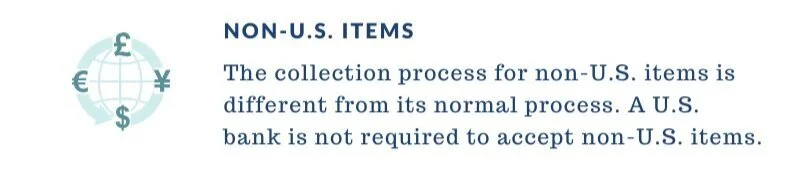


The collection process for non-U.S. items is different from its normal process. A non-U.S. item can be one of two things:

- a check payable in a currency other than U.S. dollars, or

- a check drawn on a financial institution that is not organized under United States law.

A U.S. bank is not required to accept a non-U.S. item. If it does accept the item, the bank will send the item out for “collection.” Collection is a bank-to-bank process. During the collection process for non-U.S. items, your bank will send the check directly to the other bank for payment.

Checks Returned Unpaid

When a bank is notified that a check you deposited is being returned unpaid, the amount indicated on the check is deducted from your account balance. The bank will deduct this amount even if the balance in the account is not enough to cover that amount. In addition, the bank will charge you a fee. Even further, if the account is an interest-bearing account, the bank will also deduct any interest that was accrued on the item.

To learn more about the process behind checks returned unpaid, you can refer to this infographic for more detail:

 
Click here to see our infographic on checks returned unpaid
Click here to see our infographic on checks returned unpaid


Stay tuned for Part 7 as we continue to cover basic banking.

© Whatismyhealth
Common "Cents"
Be Prepared: Common Documents for Deductions and Credits
Mar 23, 2022
Be Prepared: Common Documents for Deductions and Credits
Mar 23, 2022

A checklist of common documents related to deductions and credits that you will need when preparing to file your taxes for last year.

Read More →
Mar 23, 2022
Be Prepared: Common Income-Related Tax Documents
Feb 23, 2022
Be Prepared: Common Income-Related Tax Documents
Feb 23, 2022

A checklist of common documents related to income that you will need when preparing to file your taxes for last year.

Read More →
Feb 23, 2022
Be Prepared: Pensions, Annuities, and Social Security
Dec 29, 2021
Be Prepared: Pensions, Annuities, and Social Security
Dec 29, 2021

Discussing regular payments made through pensions and annuities, as well as social security benefits, as they relate to tax preparation.

Read More →
Dec 29, 2021
Be Prepared: Interest, Dividends and Distributions
Nov 17, 2021
Be Prepared: Interest, Dividends and Distributions
Nov 17, 2021

Discussing investments and their yields, and how these returns factor into tax preparation.

Read More →
Nov 17, 2021
Be Prepared: Wages, the W-2, and 1098-E Forms
Oct 20, 2021
Be Prepared: Wages, the W-2, and 1098-E Forms
Oct 20, 2021

Reviewing employee wages, salaries, taxes, and other forms of compensation, and how they are reported.

Read More →
Oct 20, 2021
Be Prepared: Dependents
Sep 22, 2021
Be Prepared: Dependents
Sep 22, 2021

Claiming dependents on your tax return can earn you exemptions and save you money.

Read More →
Sep 22, 2021
Be Prepared: Standard Deductions
Jul 28, 2021
Be Prepared: Standard Deductions
Jul 28, 2021

The Standard Deduction is subtracted from your income, which may lower the amount of taxes you owe.

Read More →
Jul 28, 2021
Be Prepared: The 1040 Form & Filing Status
Jun 30, 2021
Be Prepared: The 1040 Form & Filing Status
Jun 30, 2021

Being prepared to do your taxes can save you time and money. An introduction to the 1040 tax form.

Read More →
Jun 30, 2021
Being a Smart Banking Consumer: Opening a Checking Account (continued)
Nov 18, 2020
Being a Smart Banking Consumer: Opening a Checking Account (continued)
Nov 18, 2020

A final look at what is needed to open a checking account and the documents you’ll receive.

Read More →
Nov 18, 2020
Being a Smart Banking Consumer: Opening a Checking Account
May 20, 2020
Being a Smart Banking Consumer: Opening a Checking Account
May 20, 2020

Reviewing what is needed to open a checking account, and some of the documents you’ll receive when you do.

Read More →
May 20, 2020
Being a Smart Banking Consumer: Checking Terminology and 7 Important Rules
Mar 25, 2020
Being a Smart Banking Consumer: Checking Terminology and 7 Important Rules
Mar 25, 2020

Discussing important terminology and checking account rules the bank follows.

Read More →
Mar 25, 2020
WHATISMYHEALTH+PRESENTS_+%281%29.jpg
Jan 29, 2020
Being a Smart Banking Consumer: Privacy and Regulations
Jan 29, 2020
Read More →
Jan 29, 2020
Being a Smart Banking Consumer: Electronic Money Movement
Dec 18, 2019
Being a Smart Banking Consumer: Electronic Money Movement
Dec 18, 2019

Addressing digital banking basics— online banking, the Automated Clearing House System, and debit cards. 

Read More →
Dec 18, 2019
Being a Smart Banking Consumer: More Common Account Activities
Nov 27, 2019
Being a Smart Banking Consumer: More Common Account Activities
Nov 27, 2019

Covering additional account activities including normal and unusual funds availability, as well as non-U.S. items.

Read More →
Nov 27, 2019
Being a Smart Banking Consumer: Common Checking Account Activities
Oct 30, 2019
Being a Smart Banking Consumer: Common Checking Account Activities
Oct 30, 2019

Outlining the most significant types of transactions completed using checking accounts.

Read More →
Oct 30, 2019
Being a Smart Banking Consumer: Savings Accounts
Sep 18, 2019
Being a Smart Banking Consumer: Savings Accounts
Sep 18, 2019

For many people, putting money in a savings account has a certain feeling and purpose— to save money.

Read More →
Sep 18, 2019
Being a Smart Banking Consumer: Checking Accounts
Aug 21, 2019
Being a Smart Banking Consumer: Checking Accounts
Aug 21, 2019

Every bank has different names for checking accounts, but generally, they are all basically limited to a few specific types.

Read More →
Aug 21, 2019
Being a Smart Banking Consumer: Consumer Rights and Responsibilities
Jul 24, 2019
Being a Smart Banking Consumer: Consumer Rights and Responsibilities
Jul 24, 2019

Your rights and responsibilities as an account holder are set out in the agreements you sign when you open an account.

Read More →
Jul 24, 2019
Being a Smart Banking Consumer: Bank Rights and Responsibilities
Jun 26, 2019
Being a Smart Banking Consumer: Bank Rights and Responsibilities
Jun 26, 2019

Some of the most important responsibilities a bank has to you, the customer, are set out in the agreements you sign and/or agree to when you open an account.

Read More →
Jun 26, 2019
Common Cents- Infographic 1- An Introduction to Banking.png
May 29, 2019
Being a Smart Banking Consumer: An Introduction to Banking
May 29, 2019

The more information you have about why and how banks do what they do, the better consumer you can be.

Read More →
May 29, 2019
November 27, 2019/ Gene Bucciarelli/
Financial Health
health, financial health, bank, checking, savings, loan, checking account, savings account, banking, understand, information, consumer, transactions, client, CD, certificate of deposit, normal funds, availability, deposit, check, business, business day, payment, withdrawal, cash, holiday, federal, regulation, dollars, unusual funds, paid, overdraw, account, notify, hold, rights, responsibility, suspicious, suspicious activity, altered, forged, forgery, unauthorized, signature, resolved, credit, deduct, financial, Federal Reserve, clearinghouse, the FED, collection, process, payable, currency, U.S. dollars, USD, financial institution, United States, law, bank-to-bank, checks returned unpaid, unpaid, return, balance, fee, interest-bearing, interest, interest-bearing account, accrual

Gene Bucciarelli

  • Being a Smart Banking Consumer: ...
  • Being a Smart Banking Consumer: ...

Powered by Squarespace.  View Disclaimer