What Is My Health
  • Home
  • The 8 Dimensions of Health Physical Health Mental Health Intellectual Health Social Health Environmental Health Financial Health Spiritual Health Occupational Health
  • Blogs Podcast Videos Newsfeeds Resources
  • About WIMH Our Team Partners & Collaborators Contact
What Is My Health
  • Home/
  • Topics/
    • The 8 Dimensions of Health
    • Physical Health
    • Mental Health
    • Intellectual Health
    • Social Health
    • Environmental Health
    • Financial Health
    • Spiritual Health
    • Occupational Health
  • Media/
    • Blogs
    • Podcast
    • Videos
    • Newsfeeds
    • Resources
  • Info/
    • About WIMH
    • Our Team
    • Partners & Collaborators
    • Contact
Screen+Shot+2019-04-12+at+2.22.35+PM.jpg
What Is My Health

Let's change the way we see health

Common "Cents"

by Capt. Eugene Bucciarelli, CPA

What Is My Health
  • Home/
  • Topics/
    • The 8 Dimensions of Health
    • Physical Health
    • Mental Health
    • Intellectual Health
    • Social Health
    • Environmental Health
    • Financial Health
    • Spiritual Health
    • Occupational Health
  • Media/
    • Blogs
    • Podcast
    • Videos
    • Newsfeeds
    • Resources
  • Info/
    • About WIMH
    • Our Team
    • Partners & Collaborators
    • Contact
November 18, 2020

Being a Smart Banking Consumer: Opening a Checking Account (continued)

November 18, 2020/ Gene Bucciarelli

Banks are a place for us to handle our checking, savings, and possibly a loan. Beyond that, for many of us banking is a black hole. Why banks do what they do and how they do it is little understood outside of the banking community.

The more information you have, the better consumer you can be.

Being a Smart Banking Consumer

(Part 12) Opening a Checking Account (Continued)
 
WHATISMYHEALTH PRESENTS_ (1).png
 

Opening a Checking Account: What You Need

As we discussed in the first post in this series, in order to open a checking account at a bank, it’s best if you have not had a checking account forced closed in the past as the result of bouncing checks at another bank. All banks are members of a checking account tracking company. Banks will report forced closed accounts to these companies, and that information is available to all members.

As a new customer, when you walk into the bank to open a checking account, your history with other banks will be checked. Some banks will allow you to open an account even if you have had trouble with a previous bank, but these are few. Again, the moral of the story here is to treat your account and your bank in a nice way.

You will need to have a current driver’s license or official picture ID for identification. Some banks will allow you to open an account with zero money. Others want a minimum deposit. The bank will also check your name against an official possible terrorist list. You will be asked a series of questions to determine if you are a risk for money laundering.

The Documents: What You Will Receive and What They Mean For You

Here, we continue with the disclosures you will receive opening a new account:

 
WHATISMYHEALTH+PRESENTS_+%281%29.jpg
 

Electronic Funds Transfer Act (EFTA) Form

One of the more important disclosures is the Electronic Funds Transfer Act (EFTA) Form. It is intended to protect individual consumers engaging in services that involve electronic fund transfers (EFTs) and remittance transfers. The services included in the EFTA form are:

  1. Transfers through automated teller machines (ATMs). For example, transferring money from a checking account to a savings account using an ATM.

  2. Point-of-sale (POS) terminals. Typically, retail store credit card machines.

  3. Automated clearinghouse (ACH) systems. ACH systems allow for the transfer of funds electronically from the consumer to a company (or vice versa) and between companies. A common ACH transaction is the payment of payroll into your checking account from your employer.

  4. Telephone bill payment plans in which periodic or recurring transfers are contemplated.

  5. Remote banking programs, also known as online banking.

  6. Remittance transfers. Remittances are funds sent to a family in a foreign country from the U.S. These transfers are normally from one family member to another. As an example, $36 billion in remittance transfers was sent from the U.S. to Mexico in 2019—all of it sent to families in Mexico.

Electronic Funds Transfer
 
WHATISMYHEALTH+PRESENTS_+%281%29.jpg
 

The EFT deals with several subjects. Some of the key ones are:

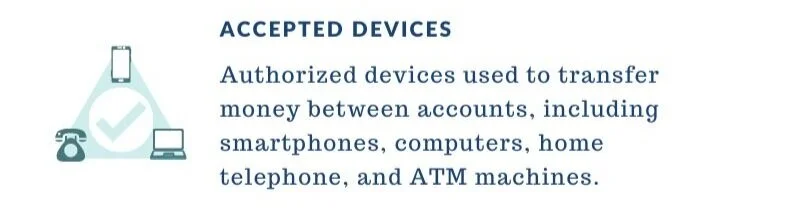
  1. Accepted Devices— An accepted access device is an access device that a consumer requests and receives, signs, or uses (or authorizes another to use) to transfer money between accounts or to obtain money, property, or services. Examples include smartphones, your computer, your home telephone, and ATM machines.

  2. Electronic Checks/ECK Transactions— In an ECK transaction, a consumer provides a check to a company. Information from the check is used to initiate a one-time electronic check from the consumer’s account. The company receiving the check must obtain the consumer’s authorization for each ECK transaction.

  3. Consumer Liability— The financial institution must include a summary of the consumer’s liability for unauthorized transfers.

  4. Consumer Information on Where to Report a Problem— A financial institution must provide a specific telephone number and address for reporting a lost or stolen access device or a possible unauthorized transfer. This information is found on, or with the disclosure statement.

  5. Error Resolution— Errors on checking, savings, and credit card transactions have certain timeframes for reporting and liability limits. A bank has the following timeframes on which to investigate:

  • Ten-day Period: A financial institution must investigate and must determine whether an error occurred within 10 business days of receiving a notice of an error. The bank must report the results to the consumer within three business days after completing its investigation. The Bank must correct the error within one business day after determining that an error occurred.

  • Forty-five-day period: If the bank is unable to complete its investigation within 10 business days, the bank may take up to 45 days from receipt of a notice of the error to investigate and determine whether an error occurred, provided the institution gives the consumer provisional credit. Provisional credit is a credit to your account for the amount of error that you reported, based on the resolution of the investigation by the bank. If the investigation finds that there was an error, then the provisional credit becomes permanent, and the investigation is concluded.

Overdraft Protection

An overdraft occurs when you write a check, but there are insufficient funds in the account to pay the check. Overdraft protection allows for payment of the transaction that creates an overdraft. This payment of the check that created the overdraft allows you, the consumer, to keep your credit in good standing with the company to whom you owe the payment.

 
WHATISMYHEALTH+PRESENTS_+%281%29.jpg
 

As a consumer, you can opt-in for overdraft protection, or you can opt-out. If utilized, the bank will charge you an overdraft fee for the overdraft. Protection programs can vary on the amount of protection, covering overdraws ranging from a few hundred dollars into the thousands.

This concludes our review of opening a checking account and the key documents you will receive.
Stay tuned for more posts about financial wellness from Common “Cents”.

©Whatismyhealth
Common "Cents"
Be Prepared: Common Documents for Deductions and Credits
Mar 23, 2022
Be Prepared: Common Documents for Deductions and Credits
Mar 23, 2022

A checklist of common documents related to deductions and credits that you will need when preparing to file your taxes for last year.

Read More →
Mar 23, 2022
Be Prepared: Common Income-Related Tax Documents
Feb 23, 2022
Be Prepared: Common Income-Related Tax Documents
Feb 23, 2022

A checklist of common documents related to income that you will need when preparing to file your taxes for last year.

Read More →
Feb 23, 2022
Be Prepared: Pensions, Annuities, and Social Security
Dec 29, 2021
Be Prepared: Pensions, Annuities, and Social Security
Dec 29, 2021

Discussing regular payments made through pensions and annuities, as well as social security benefits, as they relate to tax preparation.

Read More →
Dec 29, 2021
Be Prepared: Interest, Dividends and Distributions
Nov 17, 2021
Be Prepared: Interest, Dividends and Distributions
Nov 17, 2021

Discussing investments and their yields, and how these returns factor into tax preparation.

Read More →
Nov 17, 2021
Be Prepared: Wages, the W-2, and 1098-E Forms
Oct 20, 2021
Be Prepared: Wages, the W-2, and 1098-E Forms
Oct 20, 2021

Reviewing employee wages, salaries, taxes, and other forms of compensation, and how they are reported.

Read More →
Oct 20, 2021
Be Prepared: Dependents
Sep 22, 2021
Be Prepared: Dependents
Sep 22, 2021

Claiming dependents on your tax return can earn you exemptions and save you money.

Read More →
Sep 22, 2021
Be Prepared: Standard Deductions
Jul 28, 2021
Be Prepared: Standard Deductions
Jul 28, 2021

The Standard Deduction is subtracted from your income, which may lower the amount of taxes you owe.

Read More →
Jul 28, 2021
Be Prepared: The 1040 Form & Filing Status
Jun 30, 2021
Be Prepared: The 1040 Form & Filing Status
Jun 30, 2021

Being prepared to do your taxes can save you time and money. An introduction to the 1040 tax form.

Read More →
Jun 30, 2021
Being a Smart Banking Consumer: Opening a Checking Account (continued)
Nov 18, 2020
Being a Smart Banking Consumer: Opening a Checking Account (continued)
Nov 18, 2020

A final look at what is needed to open a checking account and the documents you’ll receive.

Read More →
Nov 18, 2020
Being a Smart Banking Consumer: Opening a Checking Account
May 20, 2020
Being a Smart Banking Consumer: Opening a Checking Account
May 20, 2020

Reviewing what is needed to open a checking account, and some of the documents you’ll receive when you do.

Read More →
May 20, 2020
Being a Smart Banking Consumer: Checking Terminology and 7 Important Rules
Mar 25, 2020
Being a Smart Banking Consumer: Checking Terminology and 7 Important Rules
Mar 25, 2020

Discussing important terminology and checking account rules the bank follows.

Read More →
Mar 25, 2020
WHATISMYHEALTH+PRESENTS_+%281%29.jpg
Jan 29, 2020
Being a Smart Banking Consumer: Privacy and Regulations
Jan 29, 2020
Read More →
Jan 29, 2020
Being a Smart Banking Consumer: Electronic Money Movement
Dec 18, 2019
Being a Smart Banking Consumer: Electronic Money Movement
Dec 18, 2019

Addressing digital banking basics— online banking, the Automated Clearing House System, and debit cards. 

Read More →
Dec 18, 2019
Being a Smart Banking Consumer: More Common Account Activities
Nov 27, 2019
Being a Smart Banking Consumer: More Common Account Activities
Nov 27, 2019

Covering additional account activities including normal and unusual funds availability, as well as non-U.S. items.

Read More →
Nov 27, 2019
Being a Smart Banking Consumer: Common Checking Account Activities
Oct 30, 2019
Being a Smart Banking Consumer: Common Checking Account Activities
Oct 30, 2019

Outlining the most significant types of transactions completed using checking accounts.

Read More →
Oct 30, 2019
Being a Smart Banking Consumer: Savings Accounts
Sep 18, 2019
Being a Smart Banking Consumer: Savings Accounts
Sep 18, 2019

For many people, putting money in a savings account has a certain feeling and purpose— to save money.

Read More →
Sep 18, 2019
Being a Smart Banking Consumer: Checking Accounts
Aug 21, 2019
Being a Smart Banking Consumer: Checking Accounts
Aug 21, 2019

Every bank has different names for checking accounts, but generally, they are all basically limited to a few specific types.

Read More →
Aug 21, 2019
Being a Smart Banking Consumer: Consumer Rights and Responsibilities
Jul 24, 2019
Being a Smart Banking Consumer: Consumer Rights and Responsibilities
Jul 24, 2019

Your rights and responsibilities as an account holder are set out in the agreements you sign when you open an account.

Read More →
Jul 24, 2019
Being a Smart Banking Consumer: Bank Rights and Responsibilities
Jun 26, 2019
Being a Smart Banking Consumer: Bank Rights and Responsibilities
Jun 26, 2019

Some of the most important responsibilities a bank has to you, the customer, are set out in the agreements you sign and/or agree to when you open an account.

Read More →
Jun 26, 2019
Common Cents- Infographic 1- An Introduction to Banking.png
May 29, 2019
Being a Smart Banking Consumer: An Introduction to Banking
May 29, 2019

The more information you have about why and how banks do what they do, the better consumer you can be.

Read More →
May 29, 2019

Special thanks to our resource:

https://fedpaymentsimprovement.org/news/blog/remittance-payments-3-cross-border-corridors-to-know/

November 18, 2020/ Gene Bucciarelli/
Financial Health
health, financial health, bank, checking account, checking, savings, savings account, loan, banking, understand, information, consumer, closed, bounced check, customer, account history, driver's license, idendification, ID, picture ID, photo ID, identification, money, minimum, deposit, risk, document, electronic, funds, transfer, Electronic Funds Transfer Act Form, Electronic Funds Transfer Act, EFTA, EFTA Form, disclose, disclosure, protect, service, ATM, credit card, retail, ACH, Automated Clearing House, company, payment, payroll, employer, telephone bill payment, bill, bill payment, recurring, recurring transfer, remote banking, online banking, remittance transfer, remittance, family, foreign country, United States, Mexico, electronic funds transfer, accepted device, device, authorize, authorized, property, smartphone, computer, home telephone, ATM machine, electronic check, check, ECK, transaction, transactions, ECK transaction, account, authorization, liability, consumer liability, financial institution, financial, unauthorized, unauthorized transfer, report, lost, stolen, disclosure statement, error resolution, ten-day period, 10-day period, investigate, error, business day, forty-five-day period, 45-day period, provisional credit, credit, provisional, resolution, permanent credit, overdraft protection, overdraft, protection, insufficient funds, owe, opt in, opt out, opt-in, opt-out, overdraft fee, overdraw, dollars

Gene Bucciarelli

  • Be Prepared: The 1040 Form & ...
  • Being a Smart Banking Consumer: ...

Powered by Squarespace.  View Disclaimer